
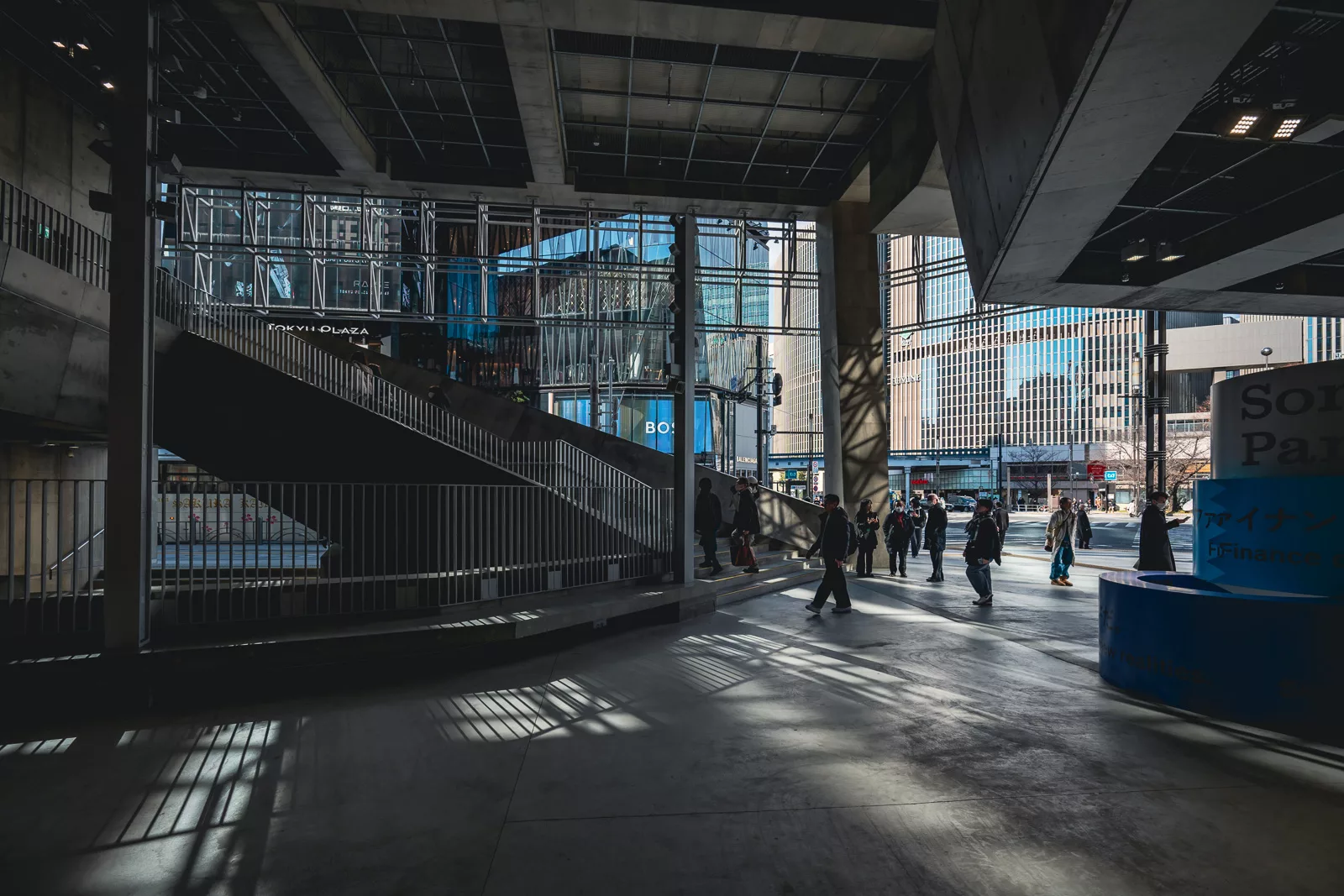
For all the talk about creating eco-friendly architecture and community spaces in Tokyo, many are simply lip service, offering a sliver of real estate for the opportunity to create marketing materials, but saving the majority of the space to maximize profits. On one of the most valuable pieces of real estate in the city, Sony has done quite the opposite at Ginza Sony Park.
A Real Community Space in Central Tokyo
On the site where the Sony Building stood for over 50 years, this relatively low concrete building might have a difficult time convincing you it is truly a park. And if your idea of a park includes a sprawling lawn and shady trees, then a park it is not. What Sony has done instead is built a facility for the community to enjoy, absolutely free of charge, promoting arts, music, and technology, three things Sony is clearly vested in.

Sony founder Akio Morita had a vision for this space to be used as a place for the community to enjoy. Even the original Sony building left a 33 square meter garden open for the public to enjoy, which may not sound like much until you consider that at one time Ginza was the most expensive real estate in the world to own. The land is still extremely valuable, but this time, Sony has gone all in and given the entire property over for the public to enjoy.
The footprint of the park belies its actual size, which is five stories above ground and three below. Floors are connected by asymmetrical staircases and a “vertical promenade” connecting the floors from top to bottom. Underground, Ginza Sony Park is connected to the Ginza subway station and as street level, it faces Sukiyabashi Crossing, the Shibuya Scramble of Ginza. Wide entrances at both places invite passers-by to step inside and have a look around.


What To See at Ginza Sony Park
There are no permanent installations at Ginza Sony Park; spaces on individual floors can be used as temporary galleries for art, music, and technology exhibitions, which is exactly what Sony is doing with them now. The B2 floor has a musical installation curated by Vaundy, a popular young artist on the Tokyo scene. Visitors are given headphones which they can plug into various ports around the installation to hear songs that have inspired Vaundy’s work. There are places to sit and relax and collections of musical memorabilia from the artists that Vaundy enjoys. The installation itself is made mainly from recycled cardboard.


On the third floor, an installation highlighting the song “Heart Beat” by YOASOBI uses haptic technology and “collects” heartbeats from participants to use in the exhibition. “Heart Beat” was written by Yoasobi by collecting text, messages, and videos from teenagers across Japan, and this installation takes it a step further, asking participants to create a “heartbeat” by combining their personality type and heart rate into a unique graphic object that is projected on the floor and walls during the program. The floor uses haptic technology to give the feeling of a heartbeat while the song plays.


On the fourth floor, an exhibit combing water and video projection brings two songs by Hitsuji Bungaku to life. This display is more performance than interactive, so visitors sit in an audience section and watch the multimedia performance. At the end of performance, we exited the room through a haptic feedback area which made it look and feel like we were walking through a pool of shallow water.
These exhibits require advance reservation, but only to control the size of the crowds. They are absolutely free and easy to register for. These three exhibition will be on until March 30th and then a new trio of exhibitions featuring the music of BABYMONSTER, Creepy Nuts, and Kensuke Ushio will replace them from April 20th to June 22nd. After that, who knows what other surprises Sony has in store.


Does Sony benefit from these free exhibitions? Well of course YOASOBI and Hitsuji Bungaku are on their music label and Vaundy has some work on one of their subsidiaries, but this is by no means an “in your face” kind of marketing strategy. At my age, I no longer listen to a lot of new artists, so this was a great opportunity to get some exposure to them (and Hitsuji Bungaku made a new fan out of me). Considering the value of the building and the property Sony basically gave to the public, I think they’re entitled to promote some of their own products on-site in a non-intrusive way.
How to Get to Ginza Sony Park
Ginza Sony Park is, surprise, in Ginza. You can access it directly from the B9 exit of Ginza Station, or about a 5 minute walk from JR Yurakucho Station on the Yamanote and Yurakucho lines. While you’re there, why not enjoy a long walk across the city, one of my favorite past times?