
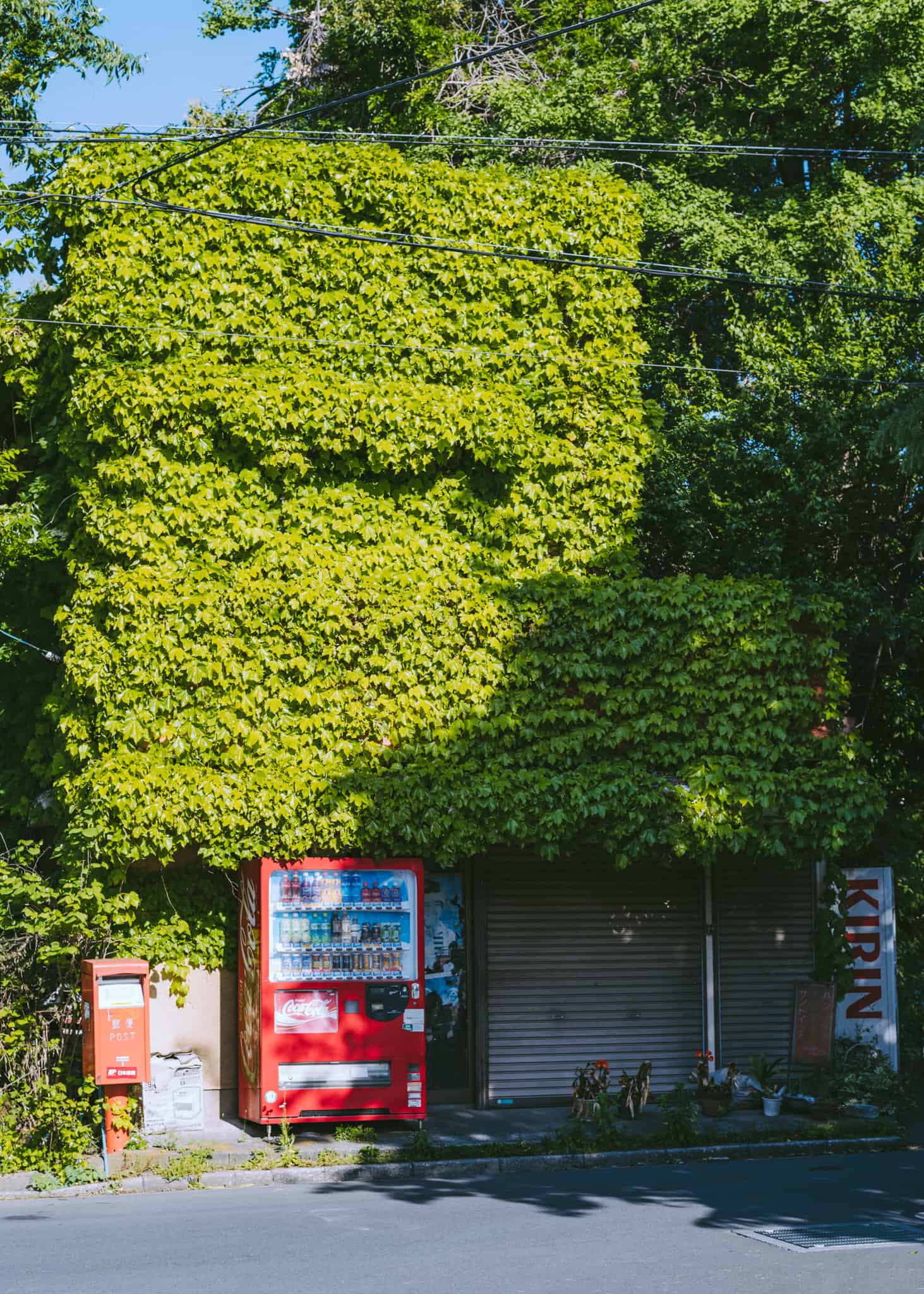
I am attracted to the old buildings in my neighborhood, particularly those with the ubiquitous vending machine standing out front. They are a nod and a wink to the days of Japan’s fading past. Some of the buildings are completely abandoned save the pleasant hum and glow of the vending machine while others continue to function as dry cleaners or perhaps tiny restaurants only locals still frequent.

I no longer hesitate to photograph these buildings as quickly as I notice them. In my few years living in Japan, I have witnessed far too many of the Showa era buildings of the mid-to-late 20th century disappear overnight, flattened into tiny parking lots for two or three compact cars or, if they’re lucky, rebuilt into some characterless cube that passes the stricter new earthquake-resistance building codes.
The idea of treasuring the old is still a difficult concept for Japan to grasp. Even a thousand years ago when the Heian dynasty ruled over a relatively peaceful and cultured Japan, the old was something to be scoffed at and modern was standard the wealthy aspired to. The Heian era lady-in-waiting Sei Shonagon, noted in her diaries that she would write new poems for her Empress on a regular basis as it would be meaningless to quote from the classic Man’yōshū, now regarded as Japan’s greatest collection of poetry.


Perhaps this disregard for the things of the past is at least part of the reason the old Edo era castles were so easily dismantled by the Meiji Government who succeeded the Shogunate, and why large swaths of Tokyo and other Japanese cities are routinely demolished to make way for generic new neighborhoods. It is certainly the reason why flea markets and antique fairs have only recently grown in popularity among Japanese; the idea of rummaging through other people’s old “junk” held little appeal to the average Japanese person.

Yet in many ways, Japan’s march through time mimics my own life. The photos of my childhood have been stored away in dusty boxes and the details of events like Christmas Day when I was five-years-old have long faded away. Even the memories of when my own children were born are becoming hazy, though fortunately not in my wife’s mind. Losing one of my important hard drives with a year or more worth of photographs on it jarred me into action earlier this year, and I spent a large sum of money investing in equipment to ensure the rest of my photographic memories would be safe for a very long time.
I wonder then, how much is the past worth to us? At my age, I sometimes feel like my mind is a bookshelf where I keep adding new books at one end while old books keep being pushed off the other. Yet, why can I still remember the phone number of my best friend from junior high school and the dialogue to more Monty Python’s Flying Circus skits than any sane person should know?

Yet if you had the choice to back up your memories like an enormous hard drive into the cloud, would you do it? We believe our thoughts are irreplaceable, but if we had access to them for the rest of our lives, would that become the digital version of the shed in our backyard where somewhere in a pile of forgotten purchases, there is a working laser disc player?